Jump to HeaderJump to Main ContentJump to Footer
Michigan State University
Michigan Center for Rural Health

Michigan Center for Rural Health

  • About Us
    • Annual Conferences
    • Staff
    • Board
    • Who We Serve
  • |
  • News
  • |
  • Programs
    • Hospital Programs
    • Improving Veterans Access to Healthcare
    • Palliative Care
    • Primary Care
    • EMS
    • Workforce
    • Social Drivers of Health
    • Northern Michigan Opioid Response Consortium
  • |
  • Education
    • Grand Rounds
    • EMS Continuing Education
    • Project ECHO
  • |
  • Resources
    • CKD Toolkit for Rural Healthcare Teams
    • Community Health Workers
    • Improving Diabetic Eye Exam Rates: A Practical Guide for RHCs
    • Rural Maternal Health Environmental Scan
    • MCRH Resource Snapshot
    • National Rural Resources
    • Newsletter Archive
    • Remote Patient Monitoring for Rural Michigan Hospitals
  • |
  • Events
  • |
  • Sponsors
Michigan Center for Rural Health
  • About Us
  • News
  • Programs
  • Education
  • Resources
  • Events
  • Sponsors

< About Us

  • Annual Conferences
  • Staff
  • Board
  • Who We Serve

< News

< Programs

  • Hospital Programs
  • Improving Veterans Access to Healthcare
  • Palliative Care
  • Primary Care
  • EMS
  • Workforce
  • Social Drivers of Health
  • Northern Michigan Opioid Response Consortium

< Education

  • Grand Rounds
  • EMS Continuing Education
  • Project ECHO

< Resources

  • CKD Toolkit for Rural Healthcare Teams
  • Community Health Workers
  • Improving Diabetic Eye Exam Rates: A Practical Guide for RHCs
  • Rural Maternal Health Environmental Scan
  • MCRH Resource Snapshot
  • National Rural Resources
  • Newsletter Archive
  • Remote Patient Monitoring for Rural Michigan Hospitals

< Events

< Sponsors

Michigan Center for Rural Health > About Us >

Who We Serve

Who We Serve

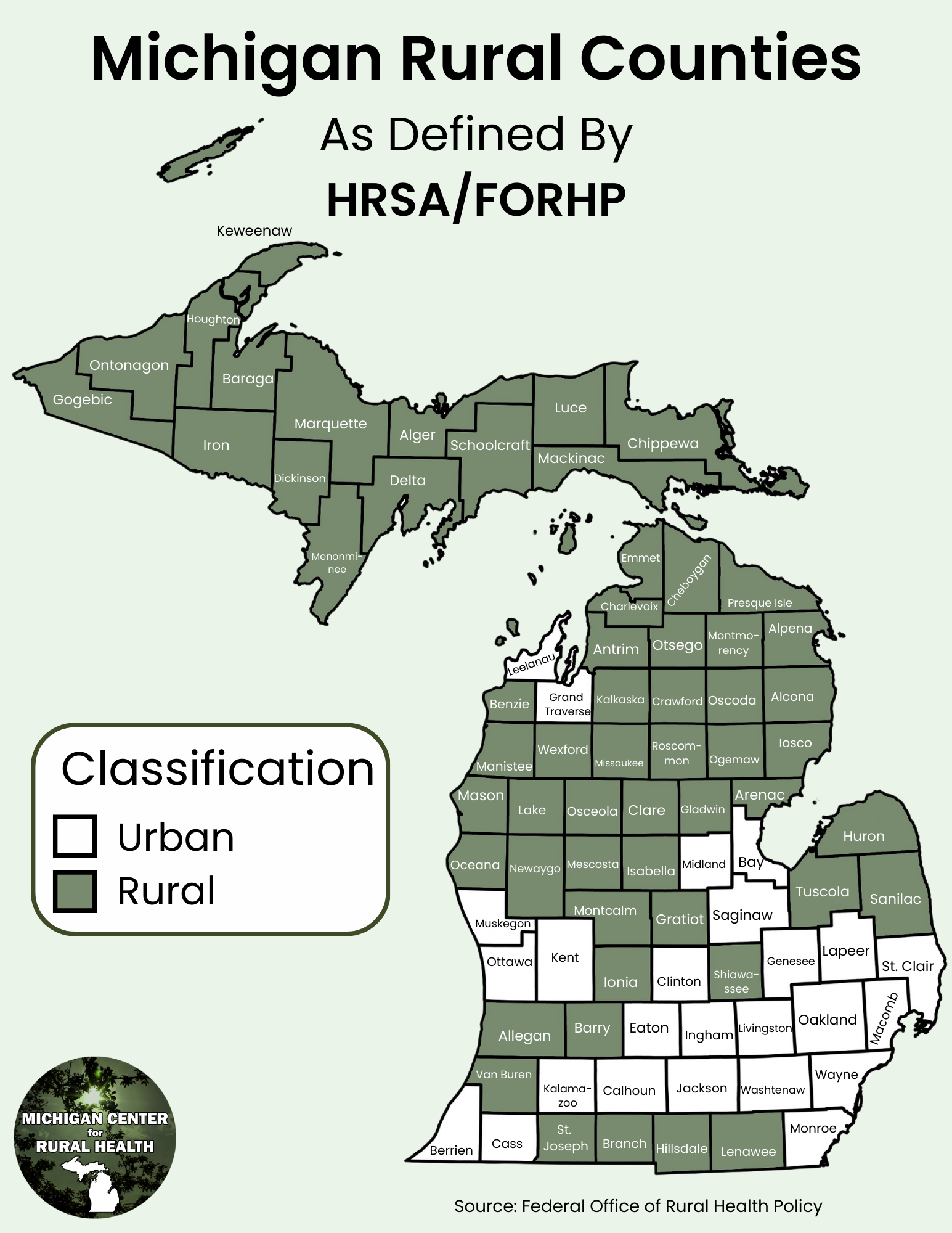
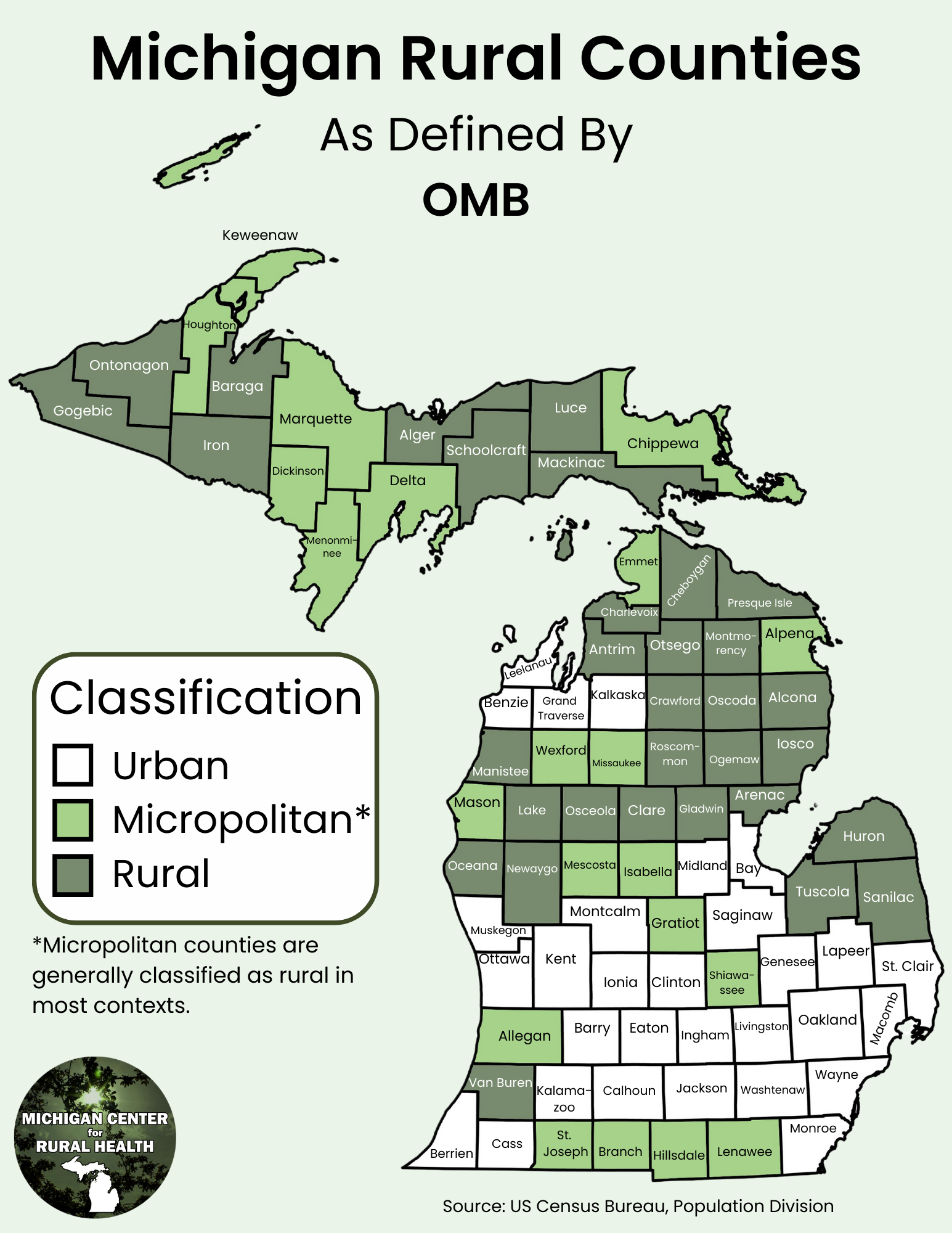
MI Rural Counties Map


MCRH is proud to offer a diverse portfolio of programming in Michigan’s rural communities. These communities include but are not limited to the rural counties represented in the map below. There are a variety of definitions for rural, and the map represents a visual of the rural counties in Michigan. Additional resources for defining rural are below:

CAH CHNA 2023

This report provides an analysis of all 61 rural counties in Michigan, focusing on the 36 Critical Access Hospitals and their identified health priorities and overall county health rankings. The health priorities listed are taken directly from the corresponding hospital's Community Health Need Assessment (CHNA). The health factors and health outcomes for each county have been provided from the Robert Wood Johnson Foundation’s county health rankings.

Resources for Defining Rural:

  • Census Bureau: The Census Bureau defines rural as any population, housing, or territory NOT in an urban area. Urban areas are organized into two categories:
    1. Urbanized areas (UAs) are 50,000 or more people
    2. Urban clusters (UCs) have 2,500 - 49,999 people. This link provides resources around the Census Bureau’s evolution of defining rural, and how nuanced data such as census tract data can be useful in defining rural.
  • HRSA: This link provides insight into how HRSA utilizes the various definitions of rural for funding prioritization. A lookup tool to determine if your organization is eligible for Rural Health Grants provided by HRSA can be found here. HRSA defines rural as the following:
    • All non-metro counties
    • All metro census tracts with RUCA codes 4-10
    • Large area Metro census tracts of at least 400 sq. miles in area with a population density of 35 or less per sq. mile with RUCA codes 2-3.
    • Beginning with Fiscal Year 2022 Rural Health Grants, all outlying metro counties without a UA are considered rural.
  • USDA: USDA defines Rural-Urban Commuting Area Codes (RUCA) which classify U.S. census tracts using measures of population density, urbanization, and daily commuting.
  • HHS Guidance Document on Defining Rural: This link provides insight into commonly used rural definitions by HHS stakeholders.
  • RHIhub “Am I Rural” Tool: This interactive service can be used to help determine whether a specific location is considered rural based on various definitions of rural, including definitions that are used as eligibility criteria for federal programs.
  • Note: Many definitions note rural census tracks – to see a listing of rural census tracks in MI, please visit page 32 of this resource.


About Us

  • Annual Conferences
  • Staff
  • Board
  • Who We Serve

News

  • News

Resources

  • CKD Toolkit for Rural Healthcare Teams
  • Community Health Workers
  • Improving Diabetic Eye Exam Rates: A Practical Guide for RHCs
  • MCRH Resource Snapshot
  • National Rural Resources
  • Newsletter Archive
  • Remote Patient Monitoring for Rural Michigan Hospitals
  • Rural Maternal Health Environmental Scan

Programs

  • Hospital Programs
  • Improving Veterans Access to Healthcare
  • Palliative Care
  • Primary Care
  • EMS
  • Workforce
  • Social Drivers of Health
  • Northern Michigan Opioid Response Consortium

Education

  • Grand Rounds
  • EMS Continuing Education
  • Project ECHO

Events

  • CAH Conference
  • Rural Health Conference
  • Opioid and Substance Use Summit
  • National Rural Health Day

Contact us

(517) 355-7979

Address

Michigan State University 909 Wilson Rd. Rm B-218 East Lansing, MI 48824

Releases and Statements

Follow Us

  • Visit our Facebook page
  • MCRH LinkedIn

If you're having accessibility issues, please let us know.

Know MoreTransparency Reporting: Budget & Salary/Compensation
  • Contact Information|
  • Site Map|
  • Privacy Statement|
  • Site Accessibility|
  • Call MSU: (517) 355-1855|
  • Visit: msu.edu|
  • Notice of Nondiscrimination|

SPARTANS WILL|© Michigan State University|

Newsletters

Are you interested in subscribing to MCRH monthly newsletters?

Subscribe